
Systems
3 min read
Polyhouse vs open field strawberry: how to decide
Protected cultivation raises yield and grade, but not equally on every site. A decision framework for Indian growers — and why you should never take the payback figure from a brochure.
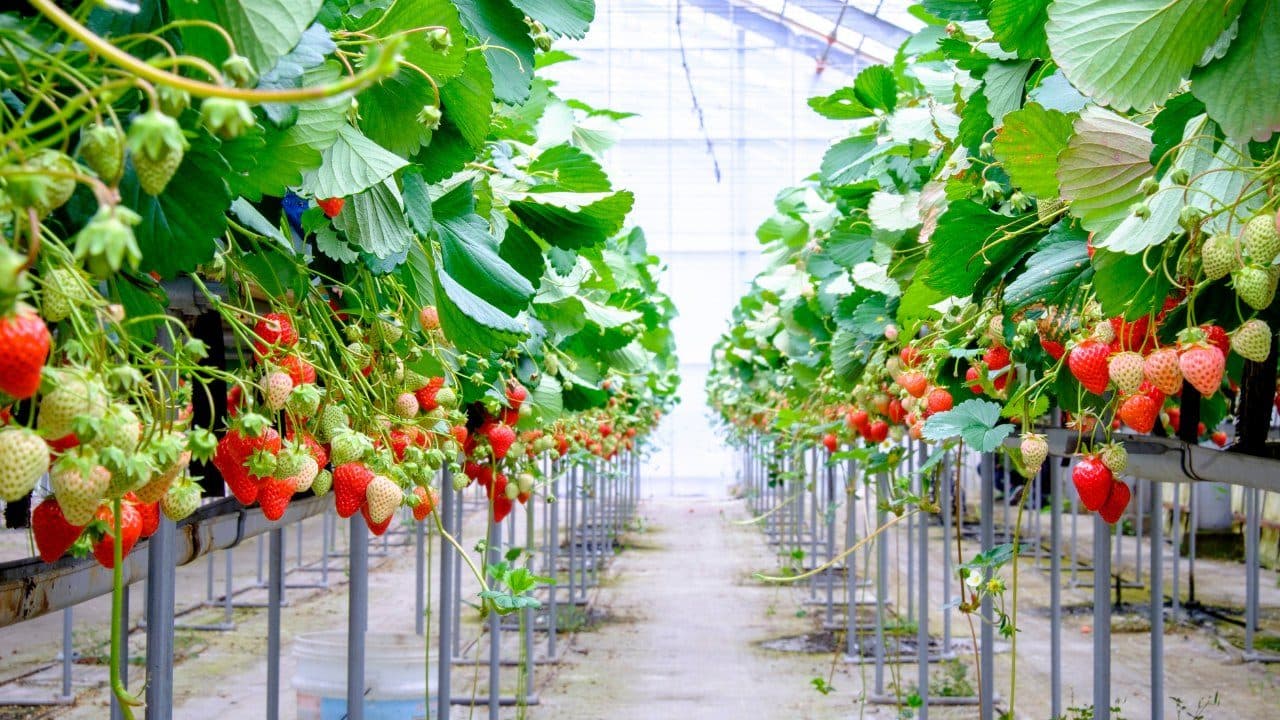
The pitch for a polyhouse is straightforward: keep rain off the fruit, hold humidity down, and you convert botrytis losses into saleable Class I fruit. All of that is true.
What the pitch leaves out is that the size of the gain depends almost entirely on how bad your rain and disease pressure were to begin with. On a dry plateau where the crop is already clean, the same structure earns back far more slowly than it does on a site that loses a pick to unseasonal rain most years.
We are not publishing capex or payback figures here. Structure costs vary by span, film grade, site and fabricator to the point where any single number would mislead you. Get three written quotations for your actual site, then run the arithmetic in the last section against your own numbers.
What protected cultivation actually changes
Rain exclusion. This is the main event in India, and it is not primarily about yield — it is about not losing a January pick outright. If you have ever watched a week's fruit split after unseasonal rain, you already know what this is worth to you, and it is a number nobody else can calculate for you.
Grade share. Cleaner fruit means a higher proportion making top grade. Since the gap between Class I and processing grade is severalfold, this often matters more to your realisation than the yield uplift does.
Season length. A structure typically pulls the season forward at one end and extends it at the other. Those shoulder weeks are when almost nobody else has fruit, so they can carry a disproportionate share of the year's profit.
Water. Less evaporative loss and better control over root-zone moisture. Real, but rarely the deciding factor on its own.
What it does not change
It does not fix agronomy. A polyhouse amplifies whatever your management already is — a badly-vented structure in a humid week will give you worse botrytis than the open field would have, because you have trapped the humidity rather than excluded the rain.
It does not help if your buyer does not pay for grade. If you sell into a local mandi that prices by the crate, most of the quality advantage evaporates between your field and the auction floor.
And it does not reduce your dependence on planting material quality, which remains the largest single cost either way.
The decision, in the order it should be made
- Have you completed a full open-field season on this site? If not, do that first. You will learn the irrigation schedule and the mite programme at a fraction of the cost of learning them inside a structure.
- How often does weather cost you fruit here? Count the seasons in the last five where rain or hail took a pick. If the answer is three or more, protection is probably the highest return capital you can deploy. If it is zero, the case is much weaker.
- Does your buyer pay for grade? If yes, model the uplift on realisation, not on tonnage. If no, fix the buyer before you fix the structure.
- Can you finance it without the shoulder weeks? Extended-season fruit commands the best prices of the year, but it is also the part of the plan most likely to slip in year one. A payback that only works if the shoulders perform is a payback that has not been stress-tested.
The middle option people skip
Walk-in tunnels and simple rain shelters cost a fraction of a full polyhouse and capture most of the rain-protection benefit without the ventilation complexity that catches out first-time growers.
For someone moving from a half acre to two acres, this is very often the right step. It is also the option least likely to be recommended to you by anyone whose business is selling structures — which is reason enough to price it yourself.
Running the numbers properly
Once you have real quotations, the calculation is simple enough to do on paper:
- Net margin per acre, open field, using your costs and your realised grade split
- Net margin per acre, protected, using the same prices and a grade share you can defend
- The difference is the annual gain the structure buys
- Divide the quoted capex by that gain, then add financing
If the result is longer than you are comfortable financing, the honest answer is that the structure is not yet right for this site — not that you should find a more optimistic yield assumption.