
Irrigation
5 min read
Stressing your strawberry crop for sweeter fruit costs half the yield
Holding back water does raise °Brix — by around a quarter. It also halves marketable yield and shrinks every berry on the plant. Here is the arithmetic, and why the trade rarely pays in an Indian market.
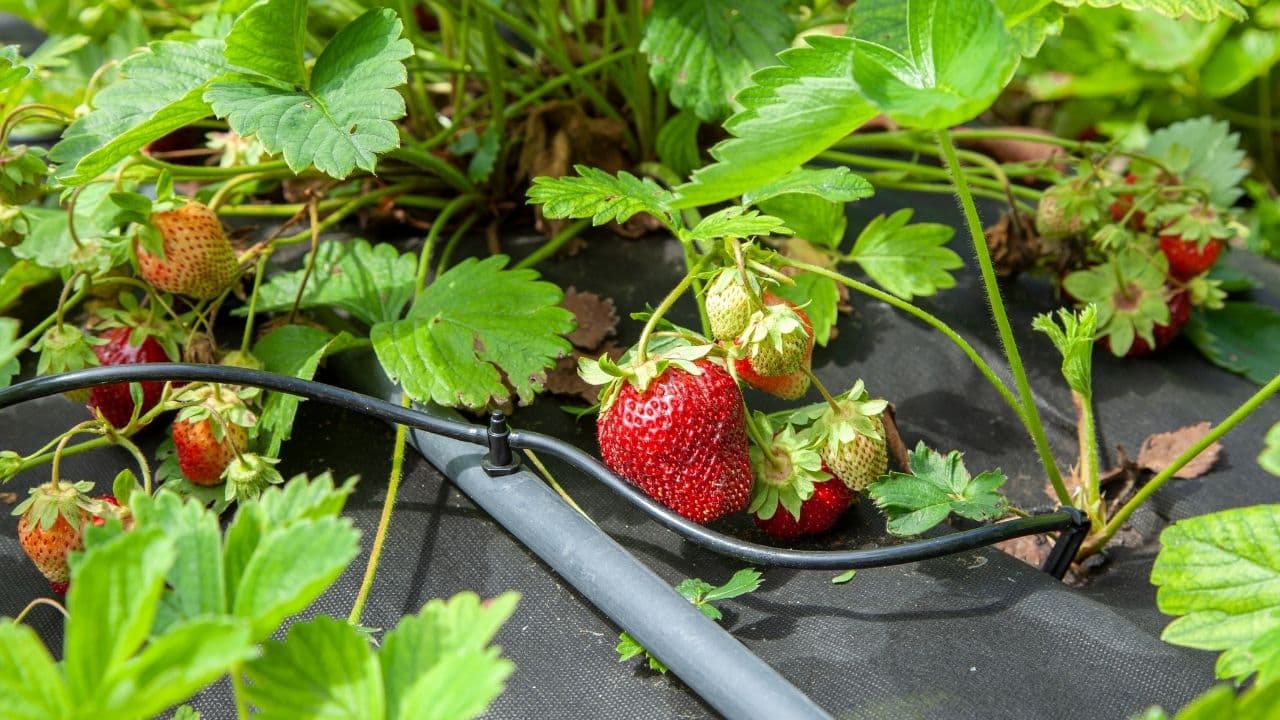
Every strawberry grower is told this at some point, usually by someone who has grown the crop longer: ease off the water before harvest and the fruit comes sweeter.
It is true. It is also one of the most expensive true things anybody will tell you about this crop.
What cutting the water actually does
Take a strawberry crop down to roughly a third of the water it wants, hold it there through the season, and this is what changes.
| Measure | Effect of running the crop dry |
|---|---|
| Marketable yield | −46% |
| Berry size | −21% |
| Fruit °Brix | +25% |
| Stomatal conductance | −30% to −33% |
| Leaf mass per area | +25% to +32% |
The sweetness gain is real and it is not small. A quarter more sugar is the difference between fruit at the market norm of around 8 °Brix and fruit at 10, which anyone eating it will notice.
The rest of that table is the bill. Yield down almost half. Every berry a fifth smaller — somewhere between 16 g and 21 g, where a good marketable berry runs closer to 28 g. Leaves thicker and denser as the plant stops spending carbon on fruit and starts spending it on survival. There is no variety that escapes this. Sweeter, smaller and fewer arrive together.
The arithmetic
Yield falls to a little over half. To earn the same money on half the tonnage, your price per kilogram has to rise by 85%.
Not rise a bit. Nearly double.
So the question is never "does withholding water make the fruit sweeter" — it does. The question is whether anyone in your chain will pay you 85% more per kilo for fruit that is a quarter sweeter and a fifth smaller. Ask your buyer that in exactly those words before you touch the irrigation controller.
Why the Indian market punishes this
Two things stack against the trade here.
Nobody down the chain measures °Brix. A refractometer is not part of how fruit is graded at a mandi, and it is not what the crate price responds to. Sweetness is invisible to the transaction. You will have paid for it in tonnage and been credited nothing.
Size is what the market does grade on, and you shrank it by a fifth. As we set out on the prices page, the gap between Class I and processing grade is severalfold, not marginal. Pushing a share of your crop down a grade boundary is the one quality change the market notices immediately — and it is the wrong direction.
Put the two together and the dry crop is smaller in volume and realises less per kilo. Against the NHB cost model, where planting material and drip cost the same whether the crop comes in or not, that is not a thinner margin. It is the margin gone.
When it is the right call
There is a case where running the crop dry is sound, and it is not the flavour case.
Per litre applied, a stressed crop is more productive: a little over half the yield on under a third of the water, which is around 69% more fruit for every litre you put on. If water is what limits you — if you are rationing a borewell across more area than you can properly irrigate — then deficit irrigation is a real lever, and the tonnage you give up per acre buys you acres you could not otherwise crop at all.
That is a water-scarcity decision, and it is a different decision from chasing sweetness. Make it on the arithmetic of your borewell, not on the flavour of the fruit.
The other case is a processor who genuinely buys on soluble solids for pulp or jam. Confirm the premium in writing first — a processor paying by weight alone gives you the worst of both.
What to expect on an Indian field
The numbers above come off a mild coastal season in substrate bags. Three things shift them on an Indian field, and all three move the same way.
Heat makes the penalty worse, not better. A Maharashtra or Bihar February pulls far harder on the plant than the climate those figures came from. Expect to lose more than 46%, not less.
Soil holds water; a bag does not. In a free-draining grow bag, cutting irrigation frequency and cutting total water are the same thing. In a soil bed with real water-holding capacity, going from six fertigation events to three does not take two-thirds of the water out of the root zone — it changes the shape of the wetting cycle. Judge what reaches the roots, not what the timer says.
Cutting water usually cuts nutrition with it. On fertigation, the two travel together unless you deliberately re-concentrate the feed. Part of what growers read as drought stress is a half-fed crop. If you are going to run dry on purpose, hold the nutrient rate up.
If you want sweeter fruit
Take the levers that do not cost you tonnage first.
Pick at full colour rather than at first blush — strawberry does not sweeten after it leaves the plant, so an early pick is sugar permanently forfeited. Pick in the cool of the morning and get the field heat out of the fruit fast. Stop pushing nitrogen late in the season, when it buys leaf at the expense of everything you are trying to taste.
Deficit irrigation is the last lever on that list, not the first.
Do not cut irrigation to improve flavour on a crop you sell by weight and grade. Cut it when water is the constraint you are actually managing, price the tonnage you are giving up before you start, and know that you are giving up close to half of it.
Source
Castro V, Zavalloni C, Liabeuf D, Pittermann J (2026). Physiological and yield tradeoffs among ten strawberry (Fragaria × ananassa Duch.) cultivars under reduced irrigation frequency. Frontiers in Sustainable Food Systems 10:1802525. doi.org/10.3389/fsufs.2026.1802525